Worried bread is too hard? Learning how to bake bread at home takes just flour, water, yeast, salt and a little sugar, plus patience while the dough rises. Mix, knead, rise, shape, bake.
You can find more pastimes to try in our hobbies section.
| Item | Value |
|---|---|
| First rise for a beginner loaf | 1 to 2 hours, until doubled in size |
| Internal temperature of most loaves and rolls | 190°F |
| Internal temperature some bakers use for dense whole grain rounds | 205°F to 210°F |
| Common supermarket yeast types | three (instant, rapid or quick-rising, active dry) |
The figures come from King Arthur’s yeast baking guide and its post on using a thermometer with yeast bread. They can change, so check the sources before you rely on them.
What you need before you start
The beginner recipe in King Arthur’s yeast guide uses flour, water, yeast, salt, and just a touch of sugar, as the guide describes. That short list is all your first loaf needs. The guide also stresses a consistently high-quality flour, and it calls this a good place for a new yeast baker to start.
Pick your yeast
Supermarket yeast comes in three types: instant, rapid or quick-rising, and active dry. The guide says they can be used interchangeably, though each acts a bit differently. Fresher yeast does its job more readily, so check the sell-by date on the packet or jar.
Active dry yeast needs proofing in warm 105-110F water, according to the Seasons and Suppers starter guide. Instant yeast can skip that step and go straight in with the dry ingredients. A bit of sugar in the proofing water is a common way to feed the yeast.
Tools worth having
You can start with a bowl and a spoon, but a few tools make bread more predictable, as the same Seasons and Suppers starter kit explains.
- Instant-read thermometer: checks the temperature of your proofing water and tells you whether a baked loaf is really done.
- Kitchen scale: many bread recipes are written in ounces or grams, and a scale helps you divide dough into even pieces.
- Loaf pans: the guide suggests 8 x 4 inch and 9 x 5 inch sizes. Metal conducts heat evenly, while glass may need an adjusted baking time.
- Stand mixer with a kneading hook: handy but optional, since a large bowl, a spoon and some elbow grease work too.
Most standard loaf recipes are written for all purpose flour, so reach for bread flour only when your recipe asks for it.
The basic method, step by step
King Arthur boils the process down to a short list, and it is aimed at people who have never baked yeast bread before. Here is the sequence from its yeast baking guide.
- Gather your ingredients.
- Mix everything together.
- Knead by hand, or using a mixer.
- Let rise for 1 to 2 hours, until doubled in size (King Arthur guide).
- Divide and shape.
- Bake and enjoy.
Everything else in this walkthrough is about the parts where beginners most often trip: how much flour to use, when the dough has risen enough, and when the loaf is baked through.
Flour, kneading and a dough that behaves
A bread recipe is never exact, because flour soaks up humidity or dries out depending on your kitchen. The Seasons and Suppers guide says to treat the flour amount as approximate and to hold back 1/4 to 1/3 of it at the start, adding it in small increments as the dough develops (source).
Go by what you see rather than by the measuring cup. Keep adding flour until the dough is soft and smooth, winds itself around the hook and cleans the side of the bowl. If you knead by hand, the same goal applies: a smooth dough that you can feel has come together.
How long should dough rise?
The King Arthur guide gives 1 to 2 hours for the first rise, until the dough has doubled in size (source). Treat that as a range, since the Seasons and Suppers guide notes that rising times vary from kitchen to kitchen and season to season.
A simple system helps you judge the size rather than the clock:
- Drop the dough ball into a large glass measuring cup, smooth side up, and note how high it reaches.
- Spray the top lightly with oil so it does not dry out.
- Cover the cup tightly with plastic wrap and wait until the dough reaches twice its starting height.
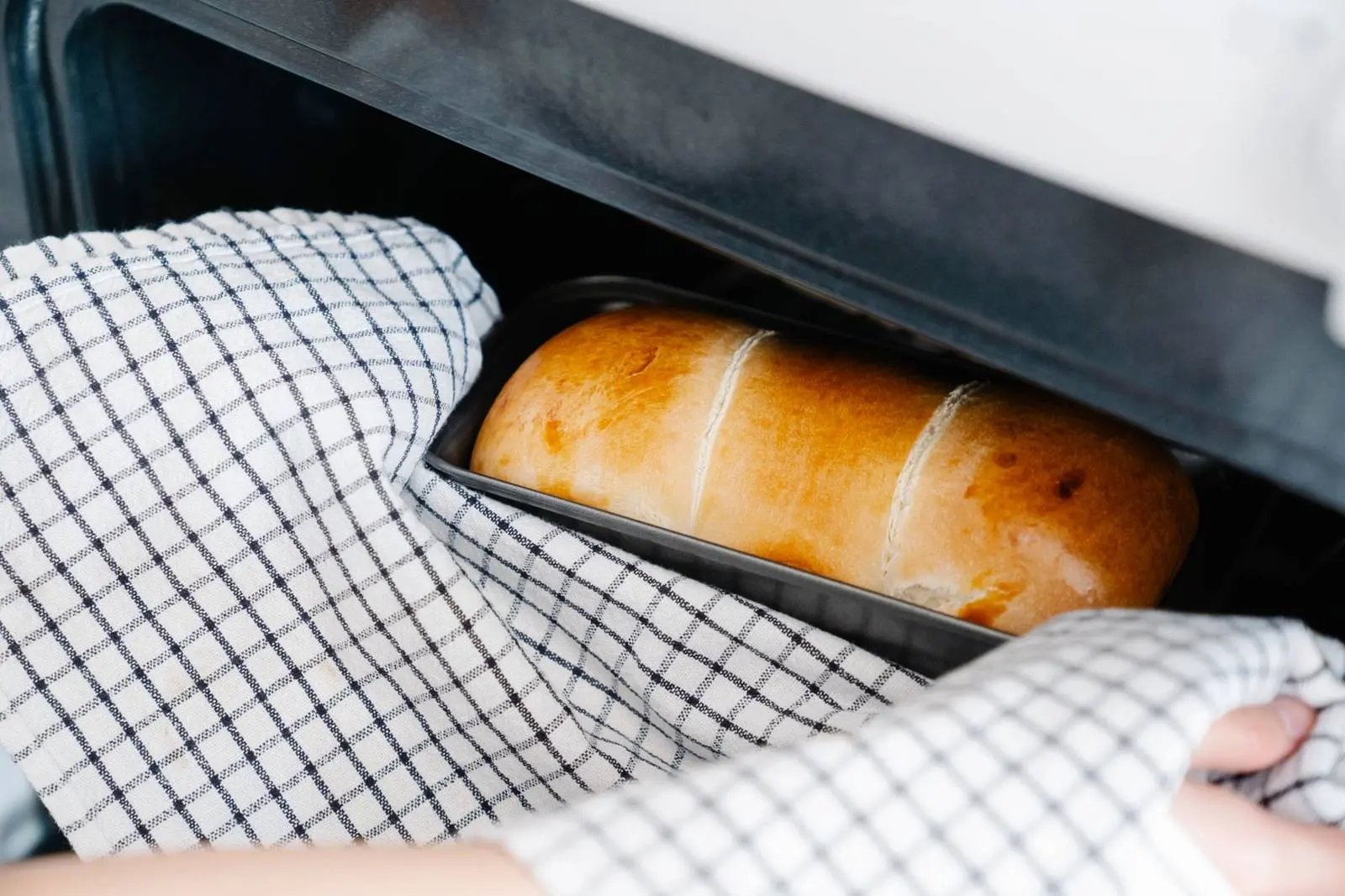
After shaping, the dough gets a second rise. In loaf pans you can cover it with a clean tea towel or with plastic wrap sprayed with oil on the underside so it does not stick (source).
How do you know your loaf is done?
Bakers have traditionally tapped the bottom of a loaf and listened for a hollow thump, which the King Arthur thermometer post calls a perfectly good method. A thermometer spares you from juggling a blistering hot loaf and gives you a number to trust.
That post says many King Arthur yeast bread recipes call for an internal temperature of 190°F, and that most loaves and rolls are done when the center reads that (source). Some breads need more:
- Most loaves and rolls: 190°F at the center.
- Baguettes: a higher internal temperature to be fully baked.
- Large, dense whole grain rounds: some bakers argue for 205°F to 210°F.
Slide the probe into the center of the loaf, since that is the last part to finish baking.
Mistakes beginners make, and where to go next
A few errors show up again and again, and the Seasons and Suppers guide covers most of them:
- Adding all the flour at once, which can leave you with a dry, stiff dough.
- Letting the dough rise longer “just to be sure”, because you can over-rise bread dough.
- Using tired yeast instead of the freshest you can find.
- Taking the loaf out before checking that the center is baked through.
Bread rewards repetition, so bake the same simple loaf a few times and change one thing at a time. If you enjoy learning with your hands, how to start knitting is another hobby you can pick up at home. And if you wonder whether a craft could ever pay for itself, there is a guide to hobbies that make money to browse.
Frequently asked questions
Can I use active dry yeast instead of instant yeast?
Show answer
Yes. King Arthur’s guide says the yeast types are interchangeable, though they behave a little differently. Just remember that active dry yeast should be dissolved in warm water first, while instant yeast does not have to be.
Do I need a stand mixer to make bread?
Show answer
No. The Seasons and Suppers starter guide points out that people made bread long before stand mixers existed, and a bowl, a spoon and effort will do. King Arthur’s beginner steps also allow for kneading by hand.
What if my dough has not doubled when the recipe says it should?
Show answer
Keep watching the dough, not the clock. Recipe times are only guidelines, and a cooler or drier kitchen can slow things down, so wait until the dough has visibly reached twice its size (source).
Is the thump test still worth using?
Show answer
It works, and plenty of bakers still rely on it. A thermometer simply lets you skip handling a hot loaf, as the King Arthur post explains.
Does fresh yeast really make a difference?
Show answer
It does. The more recently the yeast was produced, the better it does its work, which is why the guide tells you to buy the freshest you can find and to look at the sell-by date.